Carpenters are skilled manual workers who build and install structures made out of wood, wood-substitutes and other strong materials, including steel and concrete.
There are two main types of carpentry: ‘Construction’ and ‘Finishing’.
Construction carpenters work outside on construction sites, erecting the supporting frames for bridges, roads, dams and buildings.
Finishing carpenters work inside commercial and residential buildings, installing final touches such as doors, ceilings, staircases and cabinets.
The infrastructure of our cities and transport systems and the quality of our everyday surroundings depend on good carpentry.
Carpenters play essential roles in many different contexts.
Some specialise in conservation, restoring churches, halls and barns, while others work alongside stage managers, building the sets for plays and films.
With the growth of the construction industry, carpenters are in much demand in the UK and employment prospects are excellent.
Carpenters are needed to build more affordable housing and to prepare for the 2012 Olympics.
Many experienced carpenters also choose to become self-employed.
If you are physically fit, have good hand-eye coordination and can get on well with people around you, then you are likely to do well as a carpenter.
Conditions of work for carpenters vary according to the project, but workers are likely to experience some environmental pollution and will be expected to undertake some hazardous activities.
For more information, see the section Working Conditions.
Carpenters work with a range of tools:
- augers and drills for boring holes
- saws and chisels for cutting
- rulers, squares, levels and compasses for measuring
- plumb-bobs to give a straight line
- clamps for fastening
- grindstones, sandpaper and files for sharpening and smoothing.
A typical working week is 39-45 hours, with paid overtime opportunities for evenings and weekends.
Salary
Starting salaries for unqualified carpenters are around £13,500 a year.
Qualified carpenters and joiners can earn up to £23,000, and with experience this can rise to £30,000.
Responsibilities
Responsibilities vary according to whether the carpenter is based in a workshop or on site.
Those employed to create parts in workshops are referred to as ‘bench joiners’, while those employed on site to fit prefabricated parts are referred to as ‘fitters’.
Parts include doors, furniture, staircases and roof timbers.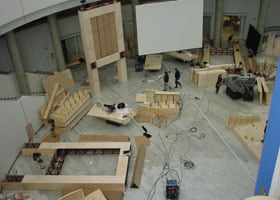
The tasks of a bench joiner include:
- Preparing wood and wood-substitutes to be cut by measuring and marking them according to instructions from a supervisor or a blueprint
- Cutting the materials and shaping/smoothing them using specialist tools
The tasks of a fitter include:
- Joining the prefabricated materials according to the design plan, using nails, screws and glues
- Installing the product on site
- Checking that the work is accurately finished, using levels or surveying equipment
- Making repairs and restoring damaged parts
Carpenters may also be required to dismantle temporary structures.
Qualifications
No qualifications are needed to begin training as a carpenter, but they are necessary if you then want to work as a skilled professional.
Apprenticeships are a good way to get your foot on the ladder.
Apprentices work alongside professionals and receive good on-the-job supervision.
There can be entry requirements for apprenticeships, such as five GCSEs or a basic vocational diploma, for instance, the Edexcel Introductory Certificate.
While working as an apprentice, you can build on your qualifications, working towards an NVQ (national vocational qualification).
Once qualified, you will have greater responsibility, earn more, and be eligible to apply for jobs.
The Construction Skills Certification Scheme will soon mean that every construction worker must carry an official card as proof of their qualifications.
The scheme will be fully enforced in 2010, but some employers are already playing by its rules.
In order to get a card, you must pass a Health and Safety test, and must either have an NVQ or pass an on-site skills assessment test.
For some jobs, a driving licence may be required in order to travel to site.
Skills
Carpentry is a skilled trade, requiring attention to detail and accuracy.
Many carpenters take pride in their work and think of themselves as perfectionists.
The geometric and algebraic skills acquired through GCSE Maths would be an advantage for measuring materials and reading blueprints.
When it comes to cutting, shaping and joining the materials, good eye-hand coordination and manual dexterity are required.
High levels of fitness and stamina are also necessary as the work involves lifting heavy materials, handling powerful tools, and long periods on your feet.
It also helps to have good balance for work involving ladders and roofs.
As with all jobs, it is important to be reliable and to maintain good working relations with your colleagues and clients.
Working Conditions
Conditions of work vary from site to site, but workers are likely to experience some environmental pollution, such as high levels of dust and noise.
Hazardous activities include climbing ladders, roof-work, lifting heavy objects, and the use of potentially dangerous tools, such as saws and drills.
Carpenters must wear protective gear, including helmets, ear-defenders and boots.
They should also be prepared to work in all weather conditions.
The working day often starts at dawn and can be long, particularly for those willing to work overtime for extra pay.
Carpentry is traditionally a male-dominated profession, although efforts are being made to encourage women to learn the necessary skills.
Some colleges now offer training courses aimed specifically at women, and awards schemes have been launched to recognise the work of exceptional women in the UK construction industry.
Experience
It is important to have some on-site experience before working towards skilled qualifications.
You might work as a labourer and shadow a carpenter to see whether the job appeals.
College courses in construction skills are also available, although most employers require these skills to be consolidated through on-site experience.
Many colleges also offer apprenticeships to give the trainee the best of both worlds.
Employers
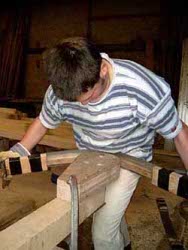
Carpenters work for construction firms, local authorities and companies specialising in interior design.
These large organisations hire carpenters through sub-contractors.
Here are some well-established sub-contractors to look out for:
- Kenford Builders Ltd: high profile projects mostly in London
- William Anelay: conservation and restoration in the UK and overseas
- JIB Construction: retail construction and shop-fitting in the South East
- GMC Projects: industrial and commercial carpentry and refurbishment
- LCC: timber frame specialists on the south coast
And some specialist companies:
- Cutting Edge: sets and stages for TV, film, theatre and conferences
- English Garden Carpentry: arbours, bridges, pergolas and pavilions
Career Progression
A carpenter’s career can take many different turns.
Here are some to think about:
- Freelance Carpenter: To be a successful freelancer it is helpful to have developed a wide range of skills for greater job flexibility. Networking is also important, as good relations with a number of sub-contractors will mean more work and higher pay. Top tip: your own workshop to minimise travel and maximise efficiency.
- Specialist Carpenter: With experience, carpenters can develop specialist skills in a particular field, such as building bridges, converting barns and farm-houses, or restoring furniture. If you have a passion for one aspect of the trade, then make a name for yourself. Top tip: a good website with quality photos of your work to inspire confidence.
- Company Director: As a successful freelancer or specialist with a great network to support your endeavours, the next step might be to start your own business. Top tip: take time to do your research and find that gap in the market.
Also known as…
- Joiner
- Chippie (British and Australian slang)
- Cabinet-maker
Related Jobs
- Cobbler
- Labourer
- Structural Engineer
- Furniture Maker
What’s it really like?
Guy Bagshaw is the founder and director of the English Garden Carpentry Company, based in Hampshire.
He tells us his story.
How did you become the director of your own company?
I started out at the age of 19 as a furniture restorer in a London workshop.
I became an experienced cabinet-maker and lectured for a couple of years at Basingstoke College of Technology until I was invited to join a carpentry company as project manager.
By that time I’d become used to being my own boss and thought it was time to set up my own company.
I took a Masters degree in Conservation of Timber-framed Buildings at Bournemouth and looked for a gap in the woodwork market.
No one else seemed to be working in English gardens, so I took the plunge.
What does it take to set a business up?
Starting a business is a labour of love and money.
I throw most of my salary back into the company and hope it will pay off when I retire.
I found a redundant farm building for a workshop and got my first jobs through previous clients.
We advertised in style magazines but the really exciting jobs came through word of mouth.
Our first projects were worth £4000 but we’re now working on a £35,000 pergola.
What’s the best thing about your job?
With your own business there is always room for fresh ideas and very little repetition.
I like the balance of mental challenge and the sheer size and volume of the pieces we create.
Another great thing about timber frame-work is that we do nothing in a very different manner to a medieval carpenter building a cathedral.
We even use the same tools: chisels, plumb-bobs and squares.
Does it pay?
Someone in my position, with a lot of experience and a good network of clients, could earn £35,000 or more.
Our trainees earn between £14,000 and £20,000.
Who do you work with?
My colleagues are from a variety of backgrounds.
Rob, from London, has a degree in sculpture.
He came to Hampshire because he couldn’t find anything quite like this in London.
We have a couple of apprentices with no professional qualifications but enthusiasm and dexterity.
Once we had a boy for six weeks’ work experience who was deaf and dumb.
He was very productive and communication didn’t prove to be a problem as long as we could get eye contact.
Tell us about a typical day.
Our day starts with a meeting in the workshop.
We go through the aims for the day and the progress of various projects.
I then spend most of the morning doing e-mails and estimates, while the apprentices plan and cut their materials and start building.
We get together for lunch and play chess and then back to work for the afternoon.
The day runs from 8.30-5.30.
What do you think it takes to be a good carpenter?
Enthusiasm, especially if you want to work in a specialist area.
An open-mind and dexterity are also essential.
For someone starting out, experience isn’t a must.
It’s more important to have the desire to produce high quality work.
And the next step for you?
Retirement! My wife and I are restoring a 15th Century house in the Massif Central in France.
It has a barn and a big open fire and vineyards not far off…