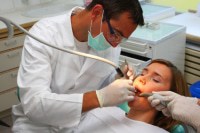
Dentists are responsible for evaluating oral health and diagnosing health problems through patient check-ups, and performing preventative work and restorative treatment on the mouth and gums.
Dentists work to promote oral health by carrying out dental work on private and NHS patients in the community or general practice.
Their work involves monitoring oral health, carrying out work to prevent tooth decay or repairing damage that has occurred to the teeth and gums.
Dentists usually work for a general practice but they may also work for the Community Dental Service, which focuses on the assessment and treatment of children, the elderly and patients with special needs.
Alternatively they may work in a private practice or as a consultant in a dental or general hospital.
Dentists who work in a practice are usually self-employed which means their work also involves making business decisions and overseeing the day-to-day running of the practice, either alone (in a small practice) or more commonly in partnership with other dental professionals.
Salary
Trainee dentists usually start on around £28,000 during their vocational training period and, once qualified, typically earn between around £30,000.
Salaries are dependant upon the amount of private and NHS work dentists undertake and on the costs of running a practice.
Typically when mixing the two, a dentist can earn between £50,000 and £100,000, with wholly private dentists earning more than £140,000.
With the exception of newly qualified dentists undertaking their work based training period, most dentists are self employed which means they share responsibility for business costs with the other dentist professionals working in the practice.
(Figures taken from Prospects.ac.uk 2016)
Responsibilities
Dentists’ responsibilities vary depending on their patients but they typically include:
- Monitoring and evaluating patients’ oral health through regular check-ups
- Filling in dental records
- Diagnosing dental conditions, infections and diseases
- Undertaking basic cleaning of teeth and gums (further tooth hygiene is usually undertaken by dental hygienists)
- Performing dental treatments such as fillings, tooth extraction and fitting dentures, bridges and crowns
- Educating patients on oral health care (teeth cleaning, flossing etc)
- Assessing treatment options and working with patients to agree treatment plans
- Referring patients to a dental hygienist or therapist when required
- Administering local anaesthetic when performing minor treatments (e.g. fillings)
- Taking X-rays
- Managing and training staff (dental nurses, receptionists, student dentists etc)
- Undertaking business-related tasks: marketing the practice, maintaining stocks of equipment, managing practice budgets etc
Qualifications
Dentists are required to undertake a Bachelor of Dentistry or a Bachelor of Dental Health degree at one of the thirteen recognised university dentist schools in the UK.
The degree usually takes five years to complete for students studying full time and includes a mixture of lectures, scientific study and practical placements in the community, hospital and surgery.
Getting on to a dentistry degree course is very competitive and requires candidates to have a minimum of three A Levels at grades ABB (or higher) including an A Level in chemistry (or other science) and maths.
Students will also need to have good GCSEs (grade A – C) in all the sciences, maths and English.
After dentists have qualified they are required to undertake a period of vocational training under the supervision of a dental practice.
Skills
Dentists are required to have an excellent knowledge of their subject, coupled with good interpersonal skills.
More specifically they must have:
- An excellent knowledge of and interest in science, particularly the science of oral health
- Good eyesight
- Good manual dexterity and a steady hand
- The ability to concentrate for long periods of time
- The ability to use specialist equipment
- The ability to communicate information about oral hygiene and treatments to patients in a clear and articulate manner
- A willingness and ability to relate to many different people
- A friendly, polite and helpful attitude towards patients
- Good motivational abilities
- Thick skin and the ability to cope with anxious or difficult patients
- The ability to gain trust and put patients at ease
- Good leadership skills (particularly when working as a partner in a surgery)
- The ability to work well as part of a team
- A high level of commitment to the job
- A good knowledge of business in order to run a practice
- The ability to stay calm under pressure, particularly when dealing with patients
Working Conditions
Dentists usually keep normal office hours working from 9 – 5.30 from Monday – Friday.
Depending on patient demands, however, dentists may sometimes be required to work at the weekends or in the evenings, particularly if there have been unforeseen delays during the day.
Experience
To qualify as a dentist, student dentists must gain a certain amount of experience in a dental practice which is incorporated into their degree course.
Getting on to the degree course is very competitive, however, so it is also worthwhile shadowing a qualified dentist before applying for a course to show commitment to the job.
It is important that dentists have experience of a wide range of patients and dental work, as part of their degree involves completing work placements with a community practice, in a general surgery and in a hospital.
This allows them to get a feel for the different aspects of dentistry and to make an informed decision about the type of work they will do once they qualify.
Employers
Most dentists work in a general practice either as a partner or a dental associate.
The Hospital Dental Service accounts for 10 % of jobs and around 6 % of dentists work for the Community Dental Service.
Dentists are also needed to teach and research in universities and to provide oral health care to soldiers in the army.
Some large corporate companies even employ dentists to undertake the oral healthcare of their employees, although this is relatively rare outside London.
Career Progression
Once newly qualified dentists have completed their work-based vocational training they usually apply to become an associate of a dental practice, which means they are self-employed in a practice owned by another dentist.
With further experience dentists can then progress to the position of partner in a practice which means they have a share of the business and the decisions which go with owning a business.
There are always more skills dentists can gain and to stay registered with the General Dental Council dentists are required to undertake 250 hours of professional development every five years.
In addition, dentists can undertake postgraduate training in a specialist area of dentistry e.g orthodontics or dental surgery
Image
Also known as…
- Dental Surgeon
Related Jobs
What’s it really like?
Ben Attenborough is 25 years old and has recently qualified as a dentist.
He gives us the inside story…
After I finished my GCSEs and A levels I went straight from school to dental school where I completed a degree to become a Bachelor of Dentistry.
I spent 5 years at dental school (at the University of Leeds) followed by one year as a vocational dental practitioner.
Nine months ago I completed my vocational training and I am now working as a full time associate dentist.
My normal day involves me getting to work for around 8.30 and seeing the general public of Mirfield (the town where I work) and the surrounding towns, doing checkups, fillings, extractions, dentures and other treatments.
Being a dentist, I love the fact that I get to use my hands in my work, treating patients and making them happy and healthy.
Every day is different and as I never know what’s coming next its rarely boring.
On the downside, the job can be very tiring as the hours of the job are often long.
I don’t always like dealing with difficult patients as there are occasions where you get verbally abused by patients or their family.
It is important to have thick skin and you need to be immune to bad breath!
To be a dentist you need to have a high level of commitment to the job and the right attitude: it is easy to get offended, flustered or stressed out when you’re treating an especially difficult patient.
It is also necessary to have an interest in medicine and good manual dexterity.
Over the next few years I will hopefully complete my first postgraduate qualification (called an MDJF) which will allow me to specialise in a particular area of dentistry.
I’m not sure what I will do yet but I am considering something called sedation dentistry.
To get into dental school you need to have good A Levels and tons of dental experience.
I would advise potential student dentists to spend as much time as possible shadowing your dentist and any others you can hook!