A pharmacy technician is a specially trained professional who receives and fills prescription requests for all manner of people so that they receive the correct medicines promptly.
A pharmacy technician is an important position in the healthcare sector, filling an essential technical role to do with dispensing medicines. Working under the supervision of a senior pharmacist, a pharmacy technician is a hands-on role, with duties including labelling of medicines, measuring of medicines, inputting and correcting prescription information and customer service, dealing with people face-to-face and by phone and email with respect to queries about their prescriptions.
Pharmacy technicians work in a variety of settings, including hospitals, chemists, high street pharmacies and nursing homes, in fact anywhere their skills might be required. It is extremely important as millions of people rely on their prescriptions in order to live their lives, and this type of work means they get them dispensed quickly and correctly.
Technicians will spend the vast majority of their working lives within the pharmacy, an office environment, as well as popping out to make deliveries to wards and the like if working in a medical institution. Working hours are variable, as although there are nine to five jobs available, depending on where you work you may have to work shifts including weekend and/or nights too.
Pharmacy technician work is by no means gender exclusive, with males and females both filling this type of post and excelling in them.
It may be the case that some training on in-house database or medical computer systems might be needed, so that a technician can access and input patient information correctly.
Salary
Like many positions, the pay for a pharmacy technician is dependent on a variety of factors, namely location and experience. Starting out a trainee technician in the NHS, for example, could expect to earn around £16,000, which goes up after completion of the training. More experienced technicians can earn roughly anything up to £23,000.
Responsibilities
The work of a pharmacy technician is fairly routine, with a set number of tasks that tend to need to be completed on a day-to-day basis; these include –
- Working on the front desk/counter dealing with customers/patients
- Answering phones
- Retrieving prescription information from the computer records
- Preparing prescriptions by measuring, mixing, weighing and packaging correctly the medicines requested
- Creating medicinal labels with instructions on dosage and safety information
- Taking inventory of medicines
- Disposing of out of date medicines
- If working in a commercial pharmacy, some standard cashier duties may be required too
Qualifications
There are a number of routes into becoming a pharmacy technician, and which one you take can dictate what qualifications you will need. Some routes mean you can work on the job with day release to complete the correct qualification (the NVQ Diploma in Pharmacy Service Skills) at college. For this you will need to show good GCSE results, with at least C grades in English and Maths, or you can go to college to gain your NVQ before starting work. Also, some NHS Trusts offer apprenticeships for pharmacy technicians. After gaining enough experience and your NVQ, you can then register with the General Pharmaceutical Council, the official body for pharmacy technicians.
Skills
Some of the aptitudes required to be a successful pharmacy technician include –
- Excellent interpersonal and communication skills, written and verbal, for dealing with customers
- The discipline to work to stringently set rules and guidelines
- IT skills
- A decent head for numbers
- Scientific ability would be helpful
- High attention to detail and a painstaking level of accuracy
Working Conditions
As mentioned above, a pharmacy technician will spend 95% of their time in the pharmacy, an office environment, so it is not a job for outdoors types! In the pharmacy a technician has access to their computer and the range of medicines they will need to fill out orders.
In terms of working hours, it really is dependent on where a technician works. In a commercial pharmacy, the hours might be the normal nine to five, while those in hospitals and nursing homes might find themselves having to work weekends and/or night shifts so that orders are dealt with promptly round the clock.
Experience
There is no real prerequisite experience needed when wanting to become a pharmacy technician, but any customer service work or scientific/medical experience of any kind would be an advantage, as it shows you have an aptitude or enthusiasm for that kind of work. As mentioned before, a fair level of achievement in GCSE and/or A Levels would also be beneficial to any application.
Employers
The largest employer of pharmacy technicians is, unsurprisingly, the NHS, which requires trained staff in every hospital and other medical institutions. However, there are other opportunities with mail order companies as well, though these are nowhere near as numerous. Lastly, nursing homes and similar organisations sometimes require the assistance of a pharmacy technician too.
Career Progression
Once qualified, it is a case of building up experience, as you can go on to gain better pay levels as your level of responsibility increases. The role is also a great stepping-stone to becoming an actual pharmacist, as you can use qualifications and experience gained to train for that role, as well as many other related medical jobs too.
Image
Also known as…
- Pharmacy Assistant
- Pharmacy Officer
Related Jobs
- Pharmacist
- Order Picker
What’s it really like?
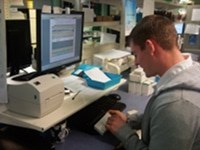
Sam Madill, aged 21, from Coventry, is a pharmacy technician at George Eliot Hospital in Nuneaton and gives us the inside story.
How long have you been doing this job?
About a year and a half.
What did you do before you did this job?
Before this I did a couple of varied jobs and experienced a certain amount of bad luck! I started sixth form and decided it wasn’t for me, and so took on a bricklaying apprenticeship. Unfortunately this didn’t come to fruition, due to funding not being there, so I took a plumbing apprenticeship with another company which, due to the recession, promptly folded! Looking for a good career to make use of my strong science and maths grades, I chanced upon the pharmacy technician path with the NHS and applied and got the position.
What is your day to day work like then?
It all depends really. Sometimes I have to do shifts on reception, answering phones and dealing with customers, whereas most of the time is spent in the pharmacy filling out orders. Now and again we have to do inventory and stock takes too.
We know pharmacy technicians sometimes have to do strange hours – what’s your typical working pattern?
I work in a hospital, on set shifts, so the hours tend to be pretty regular. I work from 9:00am-5:30pm, Monday to Friday, with a rota for Saturday work too. It tends to be about once a month this Saturday work, and is only until noon, so it isn’t all that bad. I like my hours, as I wouldn’t want to work nights or anything.
What do you like about the job?
I like to think I’m a people person, so it’s good having contact with different people. Also, I like science so it is interesting learning all about medicines, what they do and how they work. Finally, and I know this sounds a bit geeky (!), but I like the fact that what I do is important, and helps people.
Is there anything you dislike about the job?
There’s nothing that I massively dislike about the job really, though I would say that being indoors all day is sometimes annoying, as I like to be out and about in the fresh air. Apart from that, it’s great!
Is there any advice you could give to someone who wanted to become a pharmacy technician?
Study hard and listen, as some aspects of the written medicinal work can appear confusing at first. Also, when you’re at work, be sure to be accurate and follow the procedures, as these are very important and are there for safety reasons. You also have to understand that you sometimes have to deal with people who are under a lot of stress, so a certain amount of diplomacy is required at times too.
Are there any other jobs you would like to move on to?
I am currently working hard here to build experience and complete my NVQ, as I want to use these as part of my application to become a paramedic. I like working within the medical sector and this seems an interesting and fulfilling next step for me.
Where do you study for your NVQ, and how do you find it?
I study at Matthew Boulton College, a campus of Birmingham Metropolitan College. As for the actual course, it is a lot of graft and quite a bit to take in, but whenever feasible we are given study time at work to complete NVQ coursework and it is nothing a little bit of hard work can’t sort out.
What kind of things do you learn on the college course?
It’s basically disorders of the body, including the central nervous system. We also learn how and why drugs work on the body, side effects, microbiology, anatomy and physiology and about certain types of drugs, such as opiates for example, so we have an in depth knowledge of them for our work. It’s really quite interesting.
Finally, as you are still doing some form of training, what type of supervision do you receive?
There is a variety of different people who supervise us, depending on who is in at the time. NVQ assessors, senior pharmacy technicians and pharmacists all keep an eye on what we’re doing and check over our work to ensure it is in line with the guidelines. We also have a quarterly review with someone senior to go over our record and put in place goals to aim for.