A Police Officer protects the public from crime – deterring, investigating, apprehending and prosecuting criminal offenders.
The role of Police Officer is extremely important in today’s complex society where crime comes in forms ranging from minor disturbances involving out of control teenagers, to highly organised international crime rings.
At the most basic level, Police Officers on the street constitute a visual deterrent to opportunist criminals and provide a rapid response and support role to victims of an actual crime.
Meanwhile Police Officers are trained in both traditional, time honoured and state of the art technical detection techniques in order to uncover the perpetrators of complex, planned crimes.
In dealing with criminals the role of Police Officer carries with it a high level of danger.
Specialist training, working in teams and both offensive and defensive equipment such as pepper sprays, and protective vests help to minimise the danger of personal injury but do not eliminate it.
Police officers use a rage of specialist crime prevention, defence and detection equipment.
UK Police Officers may carry:
- An extendable baton.
- PAVA Incapacitant Spray
- A personal radio operating on a secure network
- A torch
- A Personal digital assistant
- Speedcuffs, the updated version of handcuffs with no chain attaching the two wrists.
All Police Constables wear a standardised uniform along with a stab proof, or a bullet proof vest according to preference.
Police officers on traffic duty or at public events wear high visibility vests and often use blunt-trauma protection vests and helmets.
Only members of the firearms unit may carry guns.
They may be seen patrolling high priority sites such as Ministry of Defence buildings and airports or operate as part of an armed response team to deal with situations where firearms are present.
Police Officers are drawn from all ethnic backgrounds and both sexes.
In order to work closely with and gain the trust of local communities, it is vital that the police force is representative of them.
Salary
A Police Officer’s salary is stratified by his rank.
Within each rank, pay increases with the length of time served along with performance related bonuses and the opportunity to work overtime.
- The starting salary of a Police Constable ranges from £21,000 to £24,000 per annum depending on location.
- A Police Constable’s pay may rise to over £33,000 after several years service.
- A Police Sergeant earns between £33,000 and £38,000 per annum depending on length of service.
- A Police Inspector’s salary starts at £43,000 rising to £48,000.
- At the very top levels of the police force, the heads of police earn in excess of £100,000.
Responsibilities
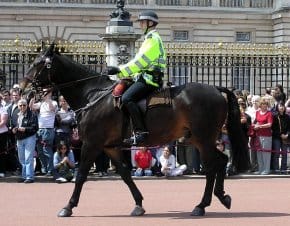
A Police Officer’s daily responsibilities are varied and may change each day along with the situations encountered.
In a normal day a Police Officer may have to perform any of the following duties:
- Meeting and conversing with local residents and small business owners.
- Making enquiries into crimes.
- Responding to emergency 999 calls.
- Interviewing suspected criminals and witnesses to crime.
- Providing emotional support to victims of crime.
- Conducting searches for missing persons.
- Giving evidence against criminals in court.
- Providing security at accident sites such as fires and car crashes.
- Providing extra security at large gatherings such as concerts, football matches and public celebrations.
- Visiting the local community to educate vulnerable citizens about crime prevention.
- Filling out reports.
- Dealing with drunk, disorderly or violent offenders.
- Arresting suspects and escorting them to the local police station for interview.
Qualifications
No official qualifications are required to begin training as a Police Officer and each police force takes care of its own recruitment procedures.
However you must:
- Be a UK citizen.
- Be over the age of 18.
- Pass background and security checks.
- Declare any previous convictions.
- Have a good standard of physical fitness and vision (the use of corrective lenses is permitted).
To be accepted onto the Police training programme you must first pass an aptitude test which focuses on areas such as decision making ability and communication skills.
There is also a psychometric, a health and a fitness test.
The first two years as a Police Officer are spent training on the IPLDP (Initial Police Learning and Development Programme).
This involves learning on the job as well as working towards an NVQ Level 3 in Policing with the requirement to attain a NVQ Level 4 in Policing around the end of the two year training period.
Skills
Dealing with the public, victims of crime and dangerous or potentially dangerous situations and people, requires a range of skills and abilities.
The personal requirements of a Police Officer would include:
- Strong communication skills, the ability to empathise with or direct a conversation.
- The ability to keep a cool head in volatile or threatening situations.
- Bravery in the face of danger but not headstrong stupidity.
- Ability to make decisions quickly and prioritise when under pressure.
- Discipline and the ability to follow orders and give them.
- Good manners when dealing with the public.
- A sense of humour and a sense of dignity.
- An honest nature.
- A strong desire to help other people before oneself.
Working Conditions
Police work is physically, emotionally and mentally tiring.
Large amounts of your time would be spent on the beat i.e. in the public sphere dealing with crimes in the community.
Back at the station, there are large amounts of paperwork to be dealt with for every crime reported.
Police Officers also have to attend court regularly to give evidence at the trials of accused criminals
Police officers work on a shift basis starting either early or late with two rest days a week.
There is the option to work extra overtime and earn more pay.
Experience
The experience needed to be a Police Officer is gained ‘on the job’ and especially during the first two years training period.
Volunteering as a youth Police Cadet will give a valuable insight into the daily working of a Police officer and may also help when it comes to applying for the job.
Employers
The Police force is the only employer of Police Officers along with the MOD (Ministry of Defence) who operate their own special Police Force.
Out of hours, Police Officers may be contracted on an advisory basis by private companies but they will then be working off-duty.
Career Progression
The Police Force recruits all position internally, therefore there is a lot of scope for motivated individuals to progress in their careers.
Aside from the linear progression from Constable, Sergeant to Inspector, then Superintendent in the territorial force, there are numerous divisions within the Police Force to deal with crimes requiring a specialist approach, such as:
- CID (Criminal Investigations Department) which deals with serious crimes involving a high level of detective work such as rape and murder.
- Mounted Police.
- Specialist Search and Recovery Team.
- Missing persons unit.
- Special Branch which includes the anti-terrorist unit, specialist protection (for key public figures) and royalty protection unit.
- Armed response unit.
- Serious and Organised Crime Group.
- High-tech crime division.
- Covert policing (undercover operations).
- Traffic support.
The HIPDS (High Potential Development Scheme) exists to fast track promising recruits who wish to study for a recognised Masters degree while serving as Police Officers.
Throughout their careers Police Officers are expected to keep their training up to date by attending specialist courses.
Also known as…
- Policeman
- Policewoman
- Police Constable
- Police Community Support Officer
Related Jobs
What’s it really like?
John Smith**, 27 yrs old has worked as a Police Officer for 9 months.
We spoke to him to find a little more about what it’s like to work on the beat in London.
What did you do before becoming a Police Officer?
Well, I’m not a fully qualified Police Officer yet, I’m still in the training stage.
Before this I worked as a Chef for four years.
Can you describe a typical day in the life of a Police Officer?
It’s quite hard to say because you never know what you are going to get.
It always starts with a briefing at the station where your Sergeant sets you some objectives to reach.
You are shown areas that you should be aware of, people that you should be aware of and known faces.
Then you go out and attend calls from the public and talk to people.
People will always stop you and tell you their problems, what goes on in the area – that’s an essential part of the day.
Then you come back to the station; if you have made an arrest you always have to do some paperwork and you will always have a debrief at the end of the day.
Common situations… domestic violence is probably the most common, along with anti-social behaviour from youths.
Things like that are generally busy till about two in the morning then they quiet down.
What do you like about being a Police Officer?
The fact that you’re trying to help people and do something to make a difference.
You try your best to help people and it is rewarding; some people really appreciate what you do.
That’s very rewarding, and the social side of the job is good.
Is there anything that don’t you like about being a Police Officer?
Sometimes it is a bit disheartening because you see the same people committing the same mistakes but the key is not to give up on them, even then.
Could you offer any advice to someone out there thinking about becoming a Police Officer?
Basically, do it because it is a job where you can make a difference.
If you want a rewarding job, to do something to change society, if you want a job where you can meet amazing people, then join the Police.
What do you think your next step would be, in terms of career progression?
The police force gives you so many opportunities.
You can grow within the job, you can grow within the organisation.
There are so many branches and so many types of job where you can develop your full potential, for example working in counter-terrorism, CID, firearms, work as a detective.
Have you got any other inside information about being a Police Office you want to share with us?
Apart from making a visible difference, you will develop yourself.
You can grow in the job.
It will mature you and teach you a lot about yourself – a lot of things you didn’t know.
It’s a very good way to learn what you can and cannot do, to know your own limits.
You put yourself to the test every single day as you develop yourself not just professionally but personally too.
Do you mind us publishing your current salary?
I get paid £29,000 per annum starting salary and you can do overtime to earn more.
**John Smith is a pseudonym used to protect the identity of our source.